The Power of Pulses And Their Synergy With Cereals!
Protein Complementation Of Pulses And Cereals!
Pulses have long been the backbone of traditional Indian diets, quietly supplying wide ranging nourishment including ample proteins, long before the term “plant protein” became fashionable.
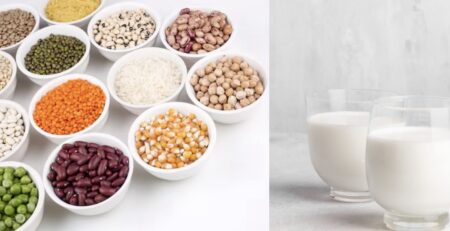
Dals or split pulses like moog (green gram), toor (pigeon pea), chana (chickpeas), udid (black gram), masur (lentils), whole moog, chana, masur (lentils)), matki (moth beans) chavli (black eyed peas or cowpeas), rajma, (kidney beans), soya are all pulses.
They are rich sources of proteins, complex carbohydrates, dietary fibre, and essential micronutrients such as B-complex vitamins—especially folate (B9), thiamine (B1), niacin (B3) and vitamin B6—with moderate amounts of riboflavin (B2), pantothenic acid (B5) and biotin (B7), minerals like iron, magnesium, and potassium.
They are not a good source of fat soluble vitamins A, D, E, K.
They are naturally low in fat (except soya), have a low glycemic load, and support gut health—making them especially valuable in vegetarian populations.
Pulses are often described as providing “incomplete protein,” as they are deficient in some essential amino acids.
Amino acids are the building blocks of proteins.
Our body needs all amino acids to be healthy. It can build some of them from other amino acids, but not all. Those it cannot build itself, have to come from food. These amino acids are called essential amino acids.
Pulses are particularly rich in lysine but are relatively low in sulphur-containing amino acids such as methionine and cysteine, and in some cases may also be modest in tryptophan.
Cereals such as rice, wheat, jowar, nachani, bajra and oats show almost the opposite pattern. They are low in lysine but provide methionine and cysteine in useful amounts and also contribute adequate tryptophan. When pulses and cereals are eaten together, their amino acids gaps neatly fill each other, resulting in a protein of much higher biological value, comparable in quality to animal proteins. This mutually beneficial interaction of amino acids of pulses and cereals is known as ‘protein complementation’.
Traditional Indian food habits have followed this principle for centuries, without any formal knowledge of nutrition science. Dal with rice, dal with chapati, moog and rice khichadi, rajma-chawal, chole-roti, idli, and dosa are all classic examples of cereal–pulse combinations that deliver complete protein in an affordable and culturally natural way. Importantly, the two foods can be consumed in the same meal or even the same day and it is sufficient for the body to utilise their amino acids efficiently.
Thus we can see that pulses are the chief protein source of the body and cereals provide only around half of their proteins, but the proteins in pulses are incomplete without the cereal proteins.
While the animal source proteins are more complete proteins than the pulses, the presence of saturated fats and cholesterol in them make them less heart friendly.
That is why many in the Western world are turning to vegetarianism.
In today’s context, this synergy between pulses and cereals is more relevant than ever. It allows vegetarian diets to meet protein needs without excessive reliance on dairy or supplements, supports muscle maintenance, immunity, enzymes, and hormones, and remains heart-friendly and sustainable.
What modern nutrition science explains in textbooks is something traditional Indian meals have quietly practised on the plate for generations.
So, to make our food nutritionally completely balanced, we must have cereals (chapati, rice, bhakri) and pulses (varan, amti, dal, sambar, usal) together in the major meals.
And we must also add milk, fruits, vegetables to our diet and use moderate amounts of the right cooking oil to cook the food.
Please also read the article ‘Basics Of Nutrition’ on this website!