Saturated Fats: Whole Milk, Ghee And Meats!
Effect Of Saturated Fats On Health!
It is well known by now that excess consumption of saturated fat and not cholesterol in foods that raise blood cholesterol and especially LDL cholesterol.
That is why many people are shunning saturated fats altogether.
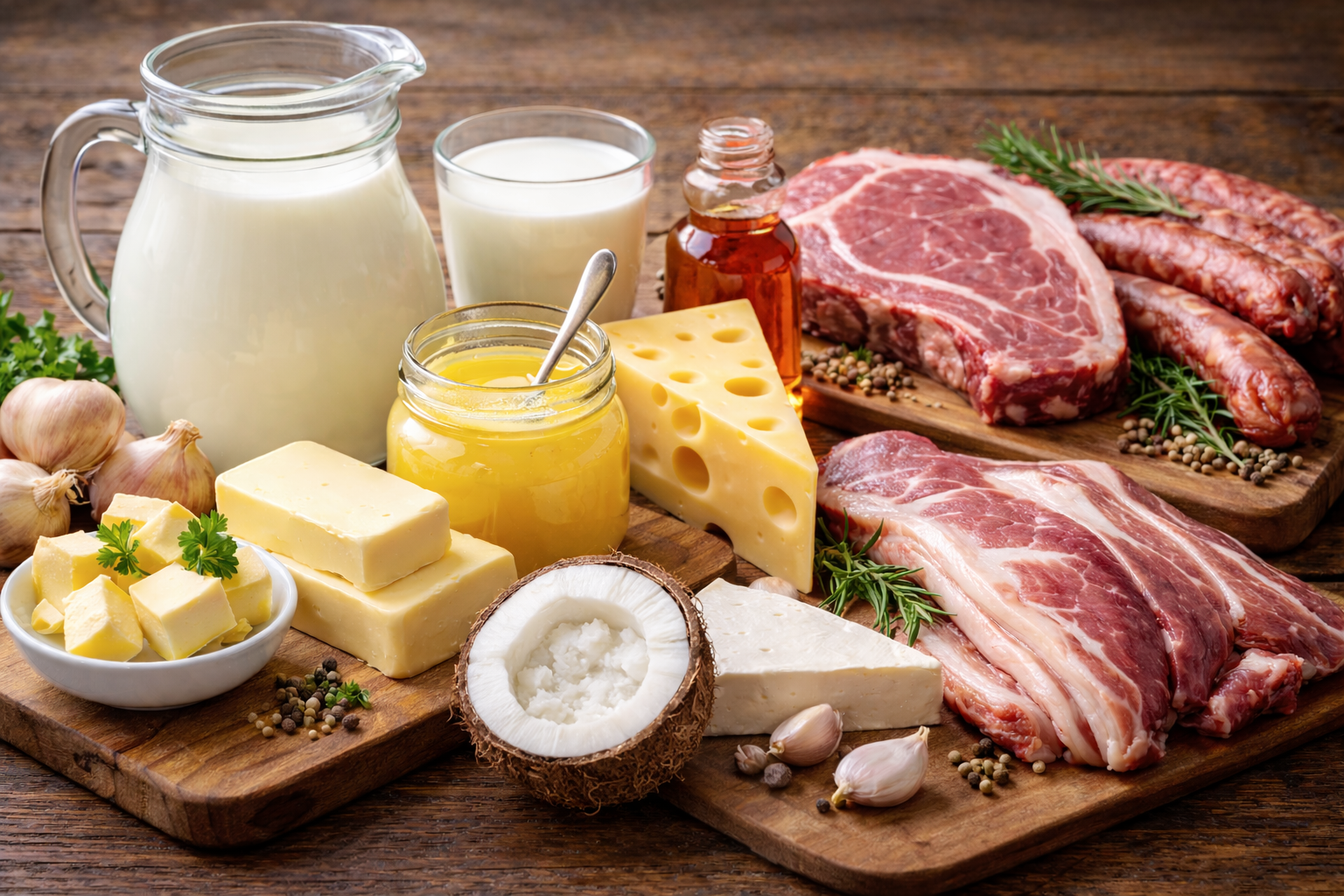
Saturated fats are found in foods like milk, curd, butter, ghee, cheese, coconut, meat, and eggs.
They are also found in ultra- processed foods like bakery items, fried snacks, and processed meats.
They are usually solid at room temperature and add flavour and richness to food.
But not all saturated fats are identical.
The saturated fatty acids found in dairy differ in composition from those found in many meats.
Milk fat contains a higher proportion of short and medium-chain fatty acids, as well as stearic acid, which has a relatively neutral effect on LDL cholesterol.
In contrast, red and processed meats tend to be richer in long-chain saturated fats like palmitic acid, which has a stronger LDL-raising effect.
This difference in fatty acid profile may partly explain why dairy fats often appear more neutral in population studies than meat-based saturated fats.
These fats tend to raise LDL (“bad”) cholesterol, while also raising HDL (“good”) cholesterol to a smaller degree. Because LDL often rises more, high intake of saturated fats can increase heart-disease risk in some people.
However, this risk depends strongly on overall diet and lifestyle.
Saturated fats eaten as part of whole foods, such as dairy, appear to be less harmful than those in ultra-processed foods like bakery items, fried snacks, and processed meats. Portion size also matters, since many saturated-fat-rich foods are energy-dense.
The sensible approach is strict moderation. Saturated fat is not a ‘free fat’, meaning you can’t eat it without limit, but it does not need to be eliminated. Using small amounts of butter or ghee, while relying mainly on unsaturated fats and eating plenty of plant foods, and regular physical activity, fits well into a healthy diet.
In short: saturated fats are best enjoyed in strict moderation, as part of a balanced, whole-food diet and physical activity — not feared, and not overused.
When observational studies say:
‘Higher ghee intake was not associated with more heart disease’
It means:
In real life, people who chose to eat ghee didn’t have more heart attacks.
Not that ghee was proven harmless under controlled trials.
And saturated fats, including ghee reliably raise LDL in controlled trials.
Higher LDL means more atherosclerosis and more heart disease.
That distinction is exactly why guidelines about saturated fat consumption remain cautious.
The WHO recommendations aim for saturated fats to be no more than about 10% of your total daily calories, with lower targets of 6%, are recommended by some heart-focused groups for higher-risk individuals.
The American Heart Association (AHA) too suggests aiming for around 6% of calories from saturated fat for heart health, which is more restrictive than the 10% guideline used in general nutrition advice.
So in an 1800 calorie diet healthy people need no more than180 calories from saturated fat.
Each gm fat gives 9 calories
So we need no more than 20 gm saturated fat in our diet.
Whole milk, whole milk curds and butter and ghee have more saturated fat than meats.
It takes no more than 2–3 tablespoons of ghee or butter in a day to cross the 10% saturated-fat limit in our diet.
Two cups of buffalo whole milk has 8 to 10 gm saturated fat.
One tablespoon of ghee has 9 to 9.3 gm saturated fat.
One tablespoon of butter has 7.5 to 7.8 gm saturated fat.
Two tablespoons of cooking oil also has, on an average, 4.4 gm saturated fat.
One 100 gm bowl of chicken or meat curry has approximately between 2 to 4.5 gm saturated fat,
depending upon which and how much cooking oil was used to cook it.
Meaning, surprisingly in 50 g cooked, skinless meat, saturated fat is about 0.8 g in chicken, 1.8 g in goat meat, and 2.7 g in lamb meat.
So you can see how easy it is to consume saturated fat, in excess of the amount advised by authorities.
And excess consumption of saturated fat can raise LDL cholesterol and can increase the risk of heart disease.
Conclusion: Eat saturated fats in moderation in a balanced diet, which includes whole grain cereals, pulses, vegetables and fruits and stay physically active!
Related articles