Are Almonds, Walnuts And Other Nuts Essential For Weight Loss?
Nuts and Weight Loss: Are They Worth the Calories?
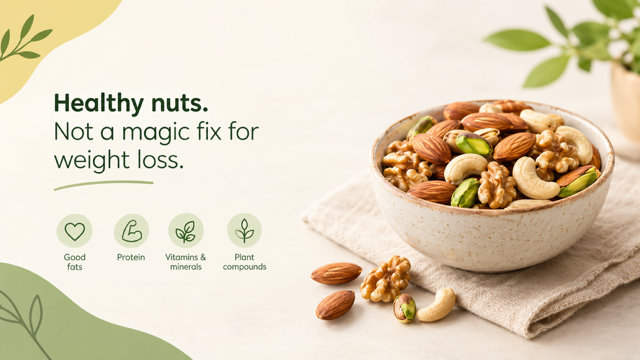
Almonds, walnuts, cashews and pistachios are widely regarded as healthy foods. They contain unsaturated fats, protein, fibre, vitamins, minerals and a variety of beneficial plant compounds. They are therefore often recommended as healthy snacks and are included in many weight-loss diets.
But an important question is often overlooked:
Do the nutritional advantages of these nuts justify the calories they contribute when they are eaten in the small portions appropriate for a weight-loss diet?
This is particularly relevant because many people who can afford nuts eat them by the handful, believing that their “healthy fats” may help with weight loss.
What do these four nuts provide?
All four nuts are energy-dense foods, providing roughly 550–650 calories per 100 grams. They also contain substantial amounts of fat, along with protein, fibre and various micronutrients and plant compounds.
Almonds provide about 580 calories and 21 grams of protein per 100 grams, with most of their fat being monounsaturated. They are also a useful source of vitamin E and various polyphenols.
Walnuts provide about 650 calories and 15 grams of protein, with a higher proportion of polyunsaturated fat. They are particularly rich in ALA, the plant form of omega-3 fatty acid, as well as several polyphenols.
Cashews provide about 550 calories and 18 grams of protein, with predominantly monounsaturated fat, along with minerals and various plant compounds.
Pistachios provide about 560 calories and 20 grams of protein, with predominantly monounsaturated fat. They also contain carotenoids, vitamin E and other polyphenols.
So, nutritionally, all four are valuable foods. But nutritional value has to be considered alongside calorie density—especially when the aim is weight loss.
What does this mean in a weight-loss diet?
A practical portion of nuts in a calorie-controlled diet may be only around 15–20 grams. Depending on the nut, this provides roughly 85–130 calories.
That small portion can certainly provide useful nutrients. But it also uses a noticeable part of the calorie allowance available for the day.
A few handfuls can easily add several hundred calories.
The fact that a food is healthy does not make its calories irrelevant.
This is one reason why the distinction between a nutritious food and a weight-loss food is important. Nuts are nutritious, but they are not low-calorie foods.
Do nuts actually help with weight loss?
There are reasonable explanations for why nuts might appear helpful during weight loss. Their protein, fibre and fat may increase satiety, and not all of their calories may be fully absorbed.
However, the more important question is what happens in actual weight-loss studies.
A recent systematic review and meta-analysis of randomised controlled trials found that adding nuts to an energy-restricted diet did not provide additional benefit for weight loss, waist circumference or body composition compared with energy restriction without added nuts. It also found no consistent additional improvement in glucose, blood lipids or blood pressure.
This does not mean that nuts are unhealthy. It simply means that there is no good evidence that adding nuts gives a special advantage for losing weight.
Nuts can certainly be part of a weight-loss diet. They just should not be regarded as having a special weight-loss effect.
What about their antioxidants and phytochemicals?
Nuts contain a variety of potentially beneficial plant compounds, including polyphenols, flavonoids, phytosterols and vitamin E. Regular nut consumption may favourably affect some cardiovascular risk factors, but the amounts of individual phytochemicals vary considerably between nuts and varieties.
It would therefore be an overstatement to expect a small daily portion of a particular nut to produce a major health benefit simply because it contains a particular antioxidant.
The value of nuts lies in their overall nutritional package rather than any single component.
What about walnuts and omega-3?
Walnuts contain considerably more ALA, an essential plant omega-3 fatty acid, than almonds, cashews or pistachios. However, ALA is not the same as the EPA and DHA found in fish, and the body’s conversion of ALA—particularly to DHA—is limited.
Walnuts are therefore a useful source of plant omega-3, but are not equivalent to fish as a source of EPA and DHA.
Do you need nuts during weight loss?
No. But you can certainly include them.
There is no nutritional requirement to add nuts to every weight-loss diet. If you enjoy them, a small portion can easily be incorporated into a balanced eating pattern.
They can be particularly useful when they replace a less nutritious snack such as biscuits, sweets or highly processed foods. In that situation, nuts may improve the overall quality of the diet without simply adding extra calories.
When total calorie intake has to remain relatively moderate, however, the amount of nuts that can realistically be accommodated in a balanced weight-loss diet is quite small. It is therefore unlikely that this small quantity, by itself, will make a major or meaningful difference to a person’s overall health.
Their nutritional benefits are real, but they should be viewed in the context of the entire diet rather than giving nuts disproportionate importance as a “superfood.”
The bottom line
Almonds, walnuts, cashews and pistachios are nutritious foods. They provide unsaturated fats, protein, fibre, vitamins, minerals and a variety of beneficial plant compounds.
They can certainly have a place in a healthy diet, including a weight-loss diet. But there is no good evidence that nuts themselves provide a special advantage in losing weight.
A small portion can provide useful nutrition, but several handfuls can contribute several hundred calories. And when calories are limited, those calories have to be considered alongside the rest of the diet.
Eat nuts because you enjoy them and because they fit into your balanced diet—not because you expect them to make you lose weight.
For weight loss and long-term health, the overall quality and quantity of the diet, appropriate portions, physical activity and the ability to sustain the lifestyle matter far more than whether nuts are included.
Related articles: